
Dr. Luis Berneth Peña
Friedrich Schiller University Jena
Everyday practices play a crucial role in understanding the division of child care and household tasks between men and women in a family. These practices involve differentiated daily routines and appropriation of the house and the city between the members of the family. Examining the routines sheds light on power dynamics, inequalities, and gender-based conflicts. It highlights the potential for creating positive and equitable family spaces to foster transformative change.
To grasp everyday practices, there is a tool called “Clock of Everyday Spatial Practices” to conduct semi-structured interviews and create databases to describe how specific persons use time and space to fulfil specific objectives. This tool is represented by a clock with concentric rings in which persons describe the regular activities and places where these are performed and the concrete action to fulfil, in this case, the childcare and household tasks. The first ring from the centre to the outside displays the hours of the day from 0-24; the second ring represents the places frequented by a person on a typical day; the third ring represents the childcare actions; and the fourth household activities.
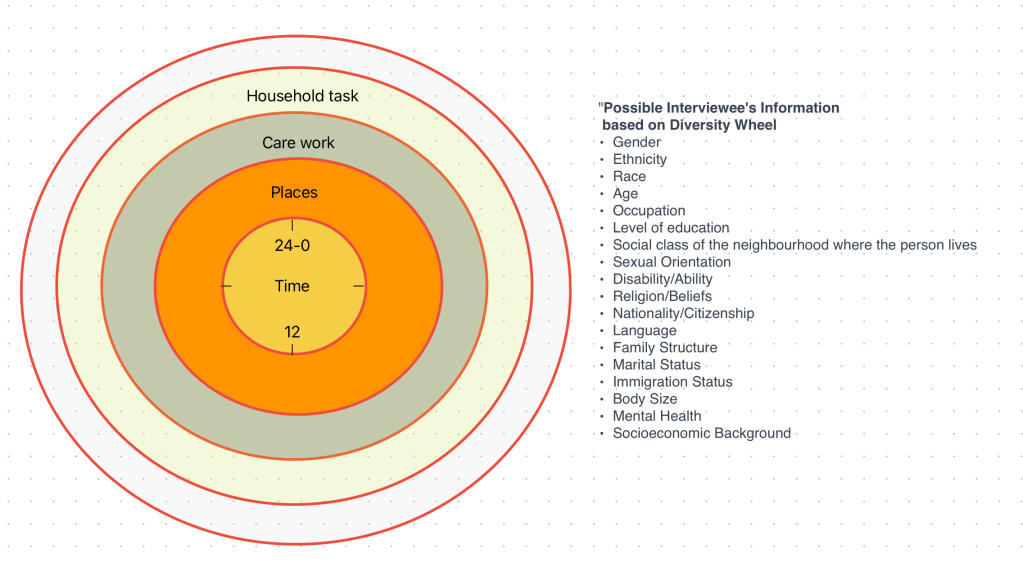
In the fieldwork or in the workshop, the work began by explaining to the interviewees that the interview sought to understand what they do in each place and time to childcare and household tasks. An A3-sized is provided interviewees with the general scheme of the four concentric circles. The interview began by asking about their age, ethnic group, gender, main activity, and the place where they live. There the interviewees were prompted to describe what a typical everyday day looks like in order to trace the sections of space-time in their daily lives. They were then prompted to describe a typical day, enabling the mapping of space-time sections in their daily lives. This process yielded sections such as home, public transport, and workplace, with the corresponding duration spent in each location. This allowed for the identification of recurring interaction scenarios. Then, the interviewees are asked to describe what they do specifically for childcare (third ring) and household task (forth ring). At the end of the interview obtain a Clock of Everyday Spatial Practices like the following samples show (the clock of the sample were used to understand other phenomena but shows the result of the interview with the Clock of Everyday Spatial Practice tool)
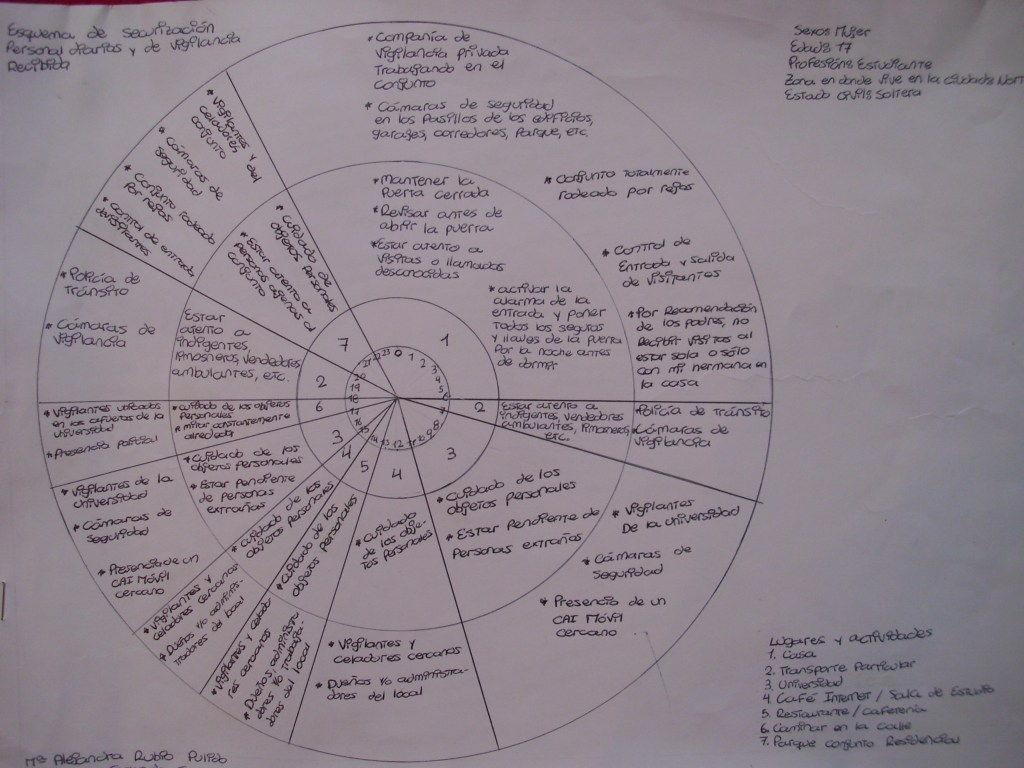
The data obtained through this tool will be coded using qualitative analysis software like Atlas.ti, allowing for comprehensive analysis and comparison of spatial practices among individuals of various characteristics. Using the “Clock of Everyday Spatial Practices” can uncover patterns, tendencies, and potential sources of conflicts or inequalities in the division of child care and household tasks between men and women. This analysis can offer valuable insights into gender roles and responsibilities within the family.
 Luis Berneth Peña
Leave a comment